
Root Cause Analysis in Pest Control: Find the Source
Professional pest management depends on eradication rather than suppression. Thorough root cause analysis in pest control shows UK servicing technicians and technical inspectors why an infestation started. Without that diagnosis, teams treat symptoms and return to the same stations month after month. Structural defects, environmental pressure and sanitation lapses keep driving activity. Methodical investigation protects client facilities, defends commercial reputations and satisfies auditors across food manufacturing, logistics and hospitality.
Resolving continuous pressure needs a framework that separates ingress routes, structural voids and food attractants from simple baiting failures. Field teams who understand how pest biology meets building maintenance deliver lasting results. How can pest professionals trace persistent infestations back to their true operational and environmental origins?
Key Takeaways
- Root cause analysis in pest control prevents repeat treatments by exposing building defects, hygiene lapses and incoming supply chain risks on commercial premises.
- Separating harbourage, entry points and food attractants stops technicians misdiagnosing persistent infestations as under-baiting or chemical tolerance on client sites.
- Historical data reveals multi-season infestation trends, helping teams distinguish external environmental migration from established internal breeding populations across a facility.
- Spatial heat maps confirm where activity clusters around doorways or machinery, supplying the visual evidence needed to justify client maintenance works.
- Prioritised, time-bound recommendations create transparent accountability between pest contractors and site operations managers during third-party hygiene and certification audits.
Core Diagnostic Categories for Site Investigation
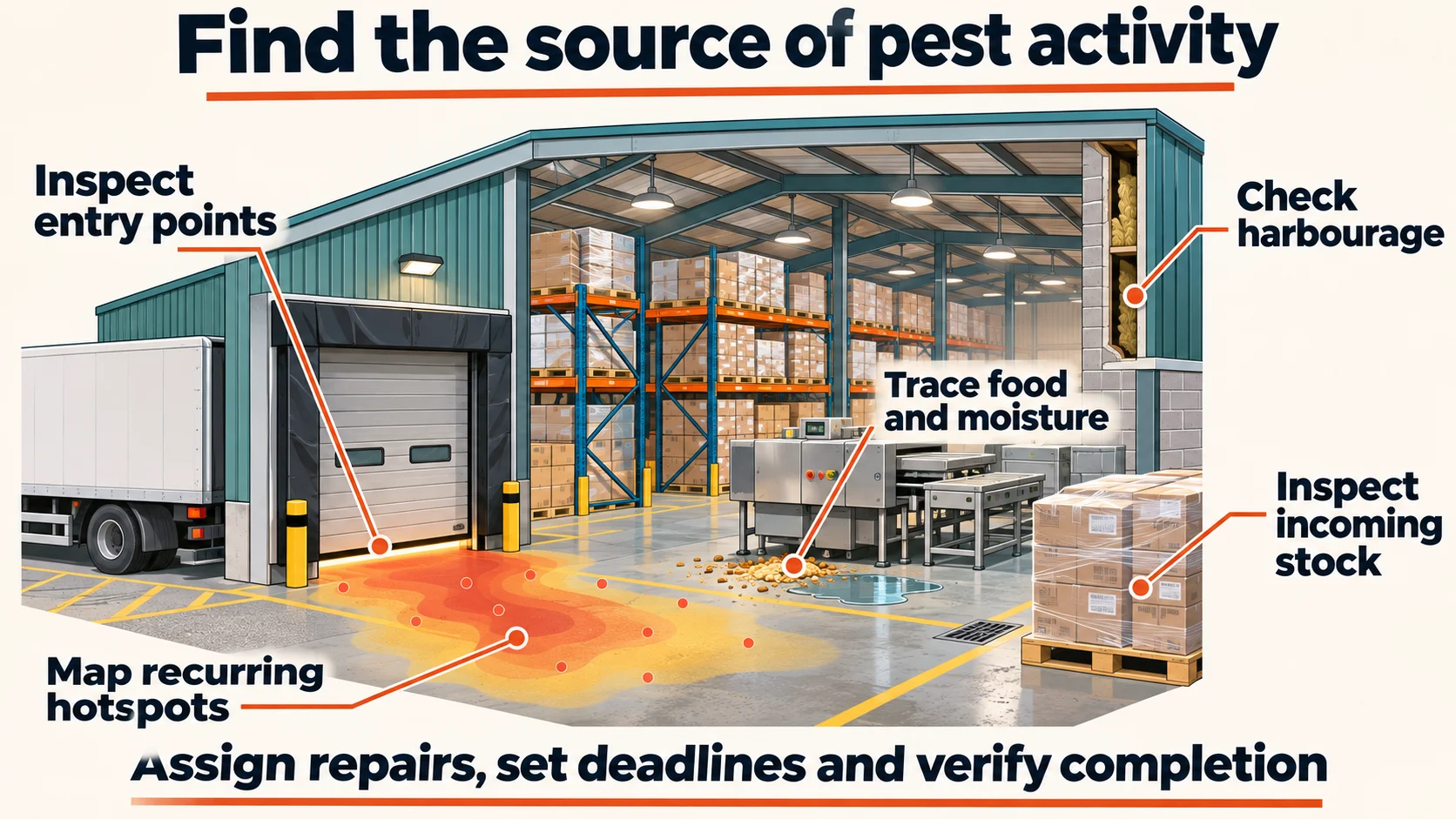
Root cause analysis is a structured diagnostic method. It weighs physical site conditions, pest biology and daily operational practice together. Rather than assuming bait shyness or resistance, technicians examine attractants, ingress and internal sanitation. The categories below shape every technical site review and keep corrective action aimed at primary drivers.
Each category carries its own field evidence and its own remedy. Working through them in order prevents a single visible symptom from dominating the report. It also produces defensible documentation for external certification audits. In practice, most stubborn infestations trace back to a combination of two or three of these categories.
| Diagnostic Category | Field Investigation Focus | Typical Corrective Measure |
|---|---|---|
| Diagnostic CategoryAccess and Ingress | Field Investigation FocusExternal doors, dock levellers, louvres, pipe penetrations | Typical Corrective MeasureRodent-resistant brush strips, welded wire mesh, escutcheon plates |
| Diagnostic CategoryHarbourage | Field Investigation FocusUnsealed hollow walls, motor housings, suspended ceilings | Typical Corrective MeasureExpanding sealants, removal of structural boxing, deep cleaning |
| Diagnostic CategoryFood and Moisture | Field Investigation FocusSpillage under equipment, drain biofilm, condensation trays | Typical Corrective MeasureRevised hygiene schedules, biological drain treatments |
| Diagnostic CategorySupply Introduction | Field Investigation FocusIncoming palletised stock, returned goods, packaging stores | Typical Corrective MeasureGoods-in quarantine, intake inspection procedures |
| Diagnostic CategoryOperational Management | Field Investigation FocusPropped fire doors, delayed repairs, waste bin discipline | Typical Corrective MeasureStaff awareness training, documented escalation workflows |
Biological Drivers Versus Under-Baiting
Competing Food Sources and Bait Refusal
Bait refusal rarely signals resistance. In practice, rodents ignore bait when richer food sits nearby. Technicians should audit waste rooms, spillage under equipment and open product before changing any formulation. Competing nutrition explains most poor bait take on commercial sites. Remove it first, then reassess the chemical strategy.
Campaign for Responsible Rodenticide Use guidance is explicit on this point. Rodenticides never substitute for sanitation and proofing. Where rodents reach high-calorie waste freely, bait take stays negligible. A full site survey must locate that nutrition and shut it off. Only then does a change in product or placement tell you anything useful about tolerance.
Species Biology and Foraging Range
Accurate identification sets the physical boundary of the investigation. Different species forage over very different distances. House mice usually range three to nine metres from the nest, so the cause sits close to the detection point. Brown rats commonly travel thirty to forty-five metres, which widens the search considerably.
Misidentification derails the whole diagnosis. A wood mouse read as a juvenile house mouse sends the technician indoors with rodenticide. Wood mice enter from surrounding fields seeking seasonal shelter. The correct response is perimeter barrier proofing, not internal baiting. Mapping species-specific ranges keeps corrective work focused on the true biological origin.
Did You Know?
Breaches of food hygiene regulations are triable either way. The Sentencing Council guideline for organisations sets an offence range from a £100 fine to £3 million. The fine is unlimited in the magistrates’ court and in the Crown Court alike.
Ingress Pathways and Structural Failure
Building Envelope Inspection Sequence
Investigation of recurring pest activity starts outside and works inward. Technicians walk the perimeter first, then the envelope, then internal rooms. High-risk features include expansion joints, rooflines, weep vents and service ducts entering through brickwork or cladding. Recording each defect in sequence builds a defect map rather than a list of sightings.
Roof level deserves the same attention as ground level. Flat roof outlets, redundant cable entries and failed mastic all admit rodents and insects. From experience across the sector, site teams inspect roof voids far less often than floors. Access equipment and a torch resolve more recurring cases than an additional bait point ever will.
Gap Thresholds and Physical Testing
External openings must be measured against known species thresholds. House mice exploit gaps larger than six millimetres. Adult brown rats pass through openings of fifteen millimetres. Technicians should test brush strips, threshold plates and pipe collars by hand. A visual check from several metres away misses compressed seals and partial gaps.
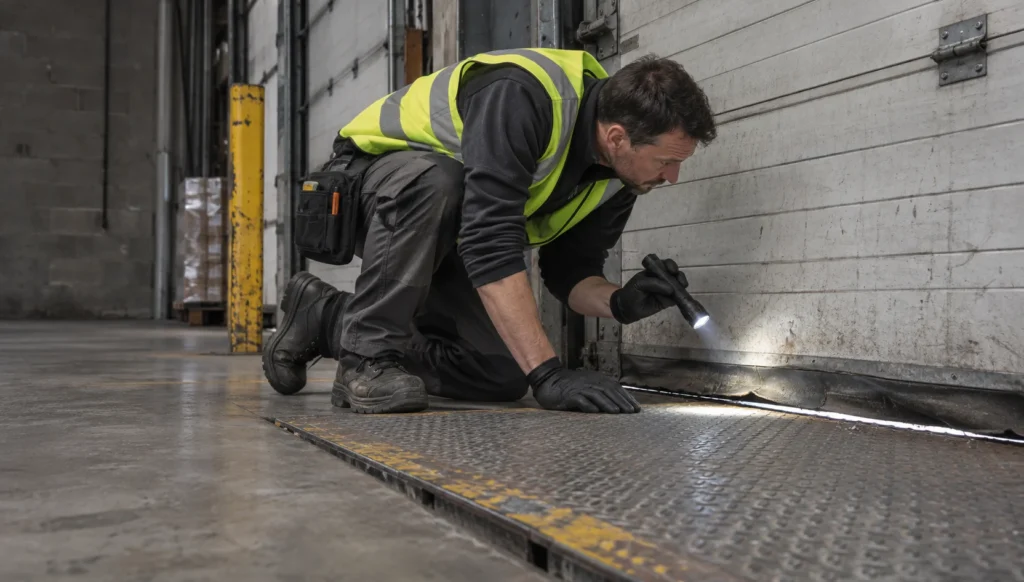
Daylight is the simplest diagnostic tool available. Close the door, stand inside and look for light along the base and jambs. Pair that with a tape measure and the evidence becomes hard to dispute. Photographs of measured gaps give site managers something concrete to take to their engineering budget holder.
AI Pest Control Analytics
Identify trends, predict risks, for smarter decisions with data-driven insights.
Pest Control Job Scheduling
Manage routine visits, call-outs, and follow-ups from one central calendar.
Analytics & Audit Reports
Turn data into clear trend graphs and detailed audit-ready summaries.
Map & Heat Map Creation
Visualise pest activity on site plans and generate professional heat maps for clients.
Mobile App for Technicians
Enable field teams to record, report, and sync jobs directly from their mobile devices.
Pest Control Recommendations
Log, assign, and close non-conformities with full client collaboration.
QR Code Pest Monitoring
Track pest activity instantly with unique QR codes linked to live site data.
Pest Control Reporting
Generate branded, audit-ready visit reports complete with images and signatures.
Internal Sanitation and Moisture Sources
Organic Debris Behind Production Equipment
Persistent infestations often survive on debris nobody can see. Grease builds under cooking lines and feeds German cockroaches indefinitely. Flour and product residue collect behind fixed machinery. Technicians should check motor housings, compressor drip trays and hollow voids beneath counters. Inspection mirrors and thermal imaging reveal what torchlight alone cannot.
Documenting these findings matters as much as finding them. A dated photograph of grease behind a fryer line shifts the conversation. It confirms that sanitation, not product performance, sustains the population. Site teams then schedule deep cleans with the right equipment removed, rather than repeating surface cleaning around the obstruction.
Drain Biofilm and Condensation Traps
Neglected floor drains produce large fly populations regardless of surface treatment. Thick organic biofilm supports drain flies and fruit flies through every life stage. Surface sprays kill adults and change nothing underneath. Condensation trays, chilled water lines and leaking seals add the standing moisture that most pests require daily.
Biological drain treatment works only after mechanical brushing breaks down the physical biofilm. Brushing precedes dosing in every case. Technicians should record which drains were treated and when, then verify with a glueboard or trap count at the next visit. Moisture faults sit with maintenance, so the recommendation must name the asset and the responsible team.
Try Insectram Free
Harbourage Versus Continuous External Entry
Life Stage Evidence and Trap Position
Technicians must separate continuous entry from internal breeding. Specimen life stages answer the question quickly. Adult flies on glueboards near external doors suggest ingress through open doorways. Larvae or newly emerged adults point to drain breeding inside. Juvenile mice deep in central ceiling voids confirm established internal nesting.
Trap position carries the same weight as the catch itself. Activity concentrated on the internal perimeter reads differently from activity in the core of a production hall. Both patterns can appear at once. Lasting control then requires work on internal harbourage and entry points at the same time.
Hidden Voids and Fabric Degradation
Commercial buildings contain false walls, hollow kickplates, conduit trunking and suspended ceilings. Each offers undisturbed harbourage within metres of production. Cracked floor tiles, failing grout and unsealed partition panels open these cavities up. Pests then nest in protected voids directly beside food preparation and packing areas.
Inspection means looking behind equipment and opening hatches. Floor-to-wall junctions show rub marks, droppings and urine staining under a UV torch. Once harbourage is identified, the contractor can advise on specific maintenance. Sealing those cavities removes the nesting ground, so external wanderers never establish a resident population.
Book a Demo
Data Analytics and Infestation Mapping
Multi-Year Incident Trends
Historical monitoring data exposes seasonal patterns and persistent trouble spots. Pest management software platforms review two years of visit records, device counts and environmental findings. That history separates predictable seasonal influx from a sudden failure in building fabric or hygiene. Raw visit sheets alone rarely make either pattern visible.
Repetition is the signal worth chasing. Autumn spikes at the same stations year after year indicate a seasonal proofing weakness. A new cluster at a station with five clean years indicates fresh damage. Trend review turns monitoring into prediction, so small ingress events get fixed before they become notifiable infestations.
Spatial Heat Maps and Catch Clustering
Digital site plans with overlaid activity confirm where evidence concentrates across large footprints. Catches are plotted by device type, including non-toxic monitors, snap traps and electronic fly killers. The resulting picture communicates far more than a numerical log sheet. Site management can see the problem area in seconds.
Dense clustering around specific dock doors or waste compactors points to localised entry or an external attractant. Engineering teams respond to that evidence far better than to prose. Heat mapping converts scattered inspection notes into graphic proof. Quality assurance teams then have objective grounds to authorise proofing works or civil repairs.
Goods-In Dock Proofing Failures
Loading Bay Vulnerabilities in Practice
Goods-in bays are the most vulnerable interface on most sites. Roller shutters open repeatedly through the shift. Pallet movement is constant and dock leveller pits create permanent structural gaps. Rats, mice and flying insects use those gaps to reach ambient warehousing directly, often within metres of stored product.
Consider a distribution centre with continuous mouse catches along bay four. Internal perimeter traps recorded activity every visit. A detailed survey found side-skirt gaps in the dock leveller pit and damaged rubber corner seals. Forklift traffic had compressed the lower door seals, leaving a twelve-millimetre opening underneath the door.
Permanent Exclusion and Verification
The contractor issued one high-priority recommendation covering both defects. It specified heavy-duty aluminium carrier brush strips across the door base and replacement rubber dock bumpers. Operatives cleaned organic debris from the pit. Fitters then closed every daylight gap with commercial draught seals around the hydraulic leveller plate edges.
Verification followed over three consecutive visit cycles. Catches fell to zero within fourteen days and stayed clear through later audits. That record proved the fix, not the chemistry, resolved the issue. Documented structural correction also demonstrated to external auditors that the site avoided permanent toxic baiting.
Recommendations, Ownership and Audit Compliance
Ownership and Enforceable Deadlines
A root cause investigation delivers nothing until findings become documented recommendations. Each report must name the responsible site contact. It must also separate contractor chemical work from client maintenance, structural repair and hygiene tasks. Without that split, every party assumes the other holds the action and nothing moves.
Vague advice fails both the site and the auditor. Improve cleaning and repair doors are not instructions. State the exact location, the precise corrective action, a priority level and a realistic completion date. Facility managers, engineering heads and cleaning contractors can then plan work against a deadline they have accepted.
Close-Out Evidence and Certification Standards
BRCGS Food Safety Issue 9 requires sites to analyse pest monitoring data for trends and act on it. Clause 4.14 drives corrective action before product or packaging is compromised. SALSA standards expect smaller producers to hold current signed site plans and investigate trends at individual control points.
Digital portals let client teams log completed work, view outstanding actions and upload photographic proof. Technicians verify those repairs on the next visit and close items with a dated photograph. Auditors scrutinise open recommendation logs closely. A closed-loop trail of this kind evidences due diligence during local authority and third-party audits.

“We regularly hear from smaller pest control companies who know they need to start their digital journey but aren’t sure where to begin. At the same time, larger businesses often come to us looking to refine or improve the systems they already have in place. This new member benefit from long-standing BPCA member and supporter Insectram offers something genuinely useful for everyone. If you’re even a little bit curious about improving how you work, I’d encourage you to give them a call and explore what’s possible.”
Final Thoughts
Systematic root cause analysis in pest control raises pest management from reactive treatment to environmental risk management. Technicians identify harbourage, unsealed entry points, sanitation lapses and incoming supply risks. Removing those drivers removes the infestation. Separating environmental failure from under-baiting also keeps treatment targeted and compliant with UK stewardship principles.
Auditing schemes continue to demand more transparency from contractors. Field decisions now need trend analysis and closed-loop recommendation tracking behind them. Sharp field biology combined with digital mapping delivers measurable, permanent exclusion. Clear accountability, enforced deadlines and verified proofing protect client compliance and lift professional standards across the sector.
Enquire About Insectram
Frequently Asked Questions
A:
The objective is to establish why pests entered and colonised a facility. Rather than suppressing numbers with repeated treatments, the method examines ingress routes, internal harbourage, food attractants and maintenance failures. Resolving those drivers delivers long-term eradication and stops costly repeat infestations. It also produces the documented preventive evidence that third-party auditors and environmental health officers expect to see during a commercial site inspection.
A:
They assess competing food sources, species feeding behaviour and recorded bait consumption before assuming the application was insufficient. Where food waste or spillage sits nearby, pests simply bypass bait. True under-baiting shows up when bait points are fully consumed between visits and feeding competition is low. Tracing sanitation lapses and measuring actual take prevents unnecessary increases in chemical use when proofing or cleaning is the real answer.
A:
Identification reveals physical capability, typical foraging range and likely origin. German cockroaches point to warm internal harbourage and introduced equipment. Oriental cockroaches point to damp basements and defective drainage. Separating house mice from wood mice decides whether the work is internal nest removal or external perimeter exclusion. Getting this wrong wastes labour, misdirects product and leaves the original cause untouched on site.
A:
Heat maps aggregate device catch data across a digital floor plan and show clustering visually. Instead of reading raw logs, technicians and site managers see activity concentrated at a loading bay, a compactor area or a specific machine. That picture pinpoints localised structural failure or a hygiene lapse. Quality assurance teams then have clear justification to authorise door proofing, structural repair or an enhanced cleaning schedule.
A:
Standards such as BRCGS Food Safety Issue 9 require recommendations to be completed within agreed risk-based timeframes. A proper log records the fault, the owner, the deadline and photographic proof of completion. Showing that structural and hygiene defects were identified, escalated and resolved demonstrates an active closed-loop programme. That evidence is what prevents a major non-conformity being raised during a formal certification audit.
About the Author
Craig Peniket
Craig Peniket brings over 30 years of hands-on pest control experience, specialising in high-compliance environments including BRCGS, SALSA, and major supermarket-audited facilities. His career has focused on integrated pest management within regulated food production and commercial environments where strict compliance, reporting, and audit readiness are essential.
He holds an RSPH Level 2 qualification alongside advanced credentials in Food Safety for Manufacturing, giving him a unique perspective on the intersection of biological control, regulatory compliance, and modern digital pest management technology used across professional pest control operations.